
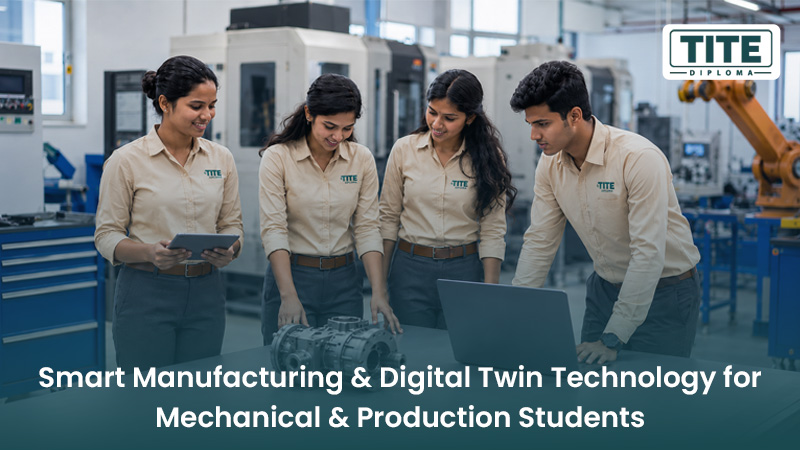
Smart Manufacturing & Digital Twin Technology for Mechanical & Production Students
Summary: Smart Manufacturing and Digital Twin Technology are transforming how mechanical and production systems are designed, monitored and optimized. These technologies enable real-time simulation, predictive maintenance and improved efficiency across industrial processes. For Mechanical & Production students, understanding these concepts is essential for careers in Industry 4.0, automation and advanced manufacturing roles.
Manufacturing has progressed remarkably from conventional production methods that relied heavily on manual operations to highly connected, automated and data-driven systems powered by Industry 4.0 technologies. Today, smart manufacturing integrates Artificial Intelligence, Industrial Internet of Things, robotics, cloud computing and Digital Twin technology to create intelligent factories capable of real-time monitoring, predictive maintenance and continuous process optimisation. For students exploring Mechanical engineering diploma colleges in Bhubaneswar, understanding these emerging technologies is essential, as modern industries increasingly seek engineers who can work with intelligent manufacturing systems and contribute to digital transformation initiatives.
Smart manufacturing and Digital Twin technology are reshaping industries by improving efficiency, reducing operational costs, enhancing product quality and enabling faster decision-making through real-time data analysis. Mechanical and Production Engineering students who develop expertise in these technologies gain a significant advantage in today's competitive job market, as they are better prepared to meet the demands of advanced manufacturing environments. Institutions such as TITE Diploma focus on combining strong engineering fundamentals with practical, industry-oriented learning to help students build the technical skills required for successful careers in the era of Industry 4.0.
What is Smart Manufacturing?
Smart manufacturing is a modern approach to production that uses advanced digital technologies to make manufacturing processes more intelligent, connected and efficient. Unlike traditional manufacturing, where machines often operate independently and decisions rely heavily on manual intervention, smart manufacturing enables machines, equipment and software systems to communicate with each other in real time. This improves productivity, reduces downtime, enhances product quality and allows manufacturers to respond quickly to changing production demands. For students considering Diploma in mechanical engineering colleges in Odisha, understanding smart manufacturing is becoming increasingly important, as industries now expect engineers to possess knowledge of digital technologies alongside core mechanical concepts.
Core Technologies Used
Smart manufacturing relies on several advanced technologies that work together to create connected and intelligent production systems.
- Industrial Internet of Things (IIoT): Connects machines, sensors and industrial equipment to collect and exchange real-time production data.
- Artificial Intelligence (AI): Analyses manufacturing data to optimise processes, predict equipment failures and support intelligent decision-making.
- Robotics: Performs repetitive, hazardous and precision-based tasks with greater speed, consistency and accuracy.
- Cloud Computing: Enables secure storage, processing and remote access to manufacturing data from multiple locations.
- Big Data Analytics: Processes large volumes of operational data to improve efficiency, product quality and resource utilisation.
- Automation Systems: Reduce manual intervention by controlling machines and production processes automatically through programmable systems.
- Smart Sensors: Continuously monitor parameters such as temperature, pressure, vibration and machine health, enabling real-time monitoring and predictive maintenance.
Features of Smart Manufacturing
Smart manufacturing offers several advanced features that significantly improve industrial operations and production efficiency.
- Real-Time Monitoring: Machines continuously generate operational data, allowing engineers to monitor production performance and identify issues immediately.
- Predictive Maintenance: Data analytics and AI detect early signs of equipment wear, enabling maintenance before unexpected breakdowns occur.
- Automated Quality Inspection: Vision systems and intelligent sensors inspect products with high accuracy, ensuring consistent quality while reducing human error.
- Connected Production Systems: Machines, departments, and supply chain operations communicate seamlessly, enabling better coordination and faster decision-making.
- Higher Productivity: Intelligent automation, improved process control, reduced downtime and efficient resource utilisation help manufacturers achieve greater productivity, lower operational costs and improved overall performance.
Understanding Digital Twin Technology
A Digital Twin is a dynamic digital replica of a physical asset, process, or system that mirrors its real-world behaviour throughout its lifecycle. Unlike a simple 3D model, a Digital Twin remains connected to the physical asset through sensors and communication networks, allowing it to receive continuous updates and accurately reflect real-time operating conditions.
Although Digital Twins and CAD models are both digital representations, they serve different purposes. A CAD model is primarily used during the design stage to create the geometry and structure of a product. It is static and only changes when manually modified by a designer. In contrast, a Digital Twin is a live, data-driven model that evolves continuously by collecting operational information from the physical asset. This enables engineers to analyse performance, simulate different scenarios, predict maintenance requirements and optimise manufacturing processes throughout the product's lifecycle.
How Digital Twins Work
Digital Twin technology operates by creating a continuous connection between a physical asset and its digital counterpart. The process typically involves the following stages:
- Physical Asset: The process begins with a real-world machine, equipment, production line or industrial system that is being monitored.
- Sensors: Various sensors installed on the asset measure important parameters such as temperature, pressure, vibration, speed, energy consumption and machine condition.
- Data Collection: The sensor data is transmitted through industrial communication networks to cloud platforms or local servers for processing and storage.
- Virtual Model: A digital replica of the physical asset is created using engineering models, simulation software and real-time operational data.
- Analysis: Artificial Intelligence and advanced analytics evaluate the collected data to identify trends, predict failures, improve performance and support decision-making.
- Continuous Feedback: Insights generated by the Digital Twin are communicated back to engineers or automated control systems, allowing real-time adjustments and continuous optimisation of manufacturing operations.
Key Benefits for Mechanical Engineering Students
As manufacturing industries rapidly adopt automation, digital technologies, and intelligent production systems, Diploma in Mechanical Engineering students must develop skills that go beyond conventional engineering concepts. Learning about smart manufacturing and Digital Twin technology helps students understand how modern factories operate, preparing them for careers in sectors such as automotive, aerospace, heavy engineering, electronics and industrial automation. These technologies bridge the gap between classroom knowledge and real-world industrial practices, making graduates more competitive in today's job market.
Better Practical Understanding
Smart manufacturing combines theoretical engineering concepts with real-time industrial applications. Students gain a deeper understanding of production planning, machine operations, process optimisation and quality control by learning how digital tools are used to monitor and improve manufacturing systems. This practical knowledge makes it easier to apply engineering principles in real industrial environments.
Industry-Relevant Skills
Modern manufacturing companies seek professionals who are familiar with Industry 4.0 technologies such as Industrial IoT, automation, robotics, artificial intelligence, cloud computing and data analytics. Learning these technologies equips students with industry-relevant technical skills that are increasingly valued across manufacturing sectors. It also helps them adapt quickly to evolving workplace technologies.
Improved Problem Solving
Digital Twin technology allows students to analyse production data, identify equipment issues and evaluate different solutions in a virtual environment before making changes to physical systems. This develops analytical thinking, critical reasoning, and structured problem-solving abilities, enabling future engineers to make informed decisions while reducing operational risks.
Enhanced Design Skills
By working with digital models, simulation software and virtual manufacturing environments, students improve their design and engineering capabilities. They learn how to evaluate product performance, optimise manufacturing processes and refine engineering designs before production begins, leading to better product quality and reduced development time.
Better Employability
Knowledge of smart manufacturing technologies gives students a significant advantage during campus placements and job interviews. Employers increasingly prefer candidates who understand automation, digital manufacturing, predictive maintenance and intelligent production systems. These competencies open opportunities across manufacturing industries, research organisations and technology-driven enterprises.
Readiness for Industry 4.0
Industry 4.0 is transforming the global manufacturing landscape by connecting machines, data and intelligent systems. Students who gain exposure to smart manufacturing and Digital Twin technology are better prepared to work in digitally connected factories, manage advanced production systems and contribute to continuous innovation. This future-ready skill set enhances long-term career growth and enables graduates to succeed in an increasingly technology-driven manufacturing industry.
Skills Students Should Learn
To build a successful career in modern manufacturing, students should develop technical skills that align with Industry 4.0 requirements. Along with core engineering concepts, gaining expertise in the following areas can improve practical knowledge and career opportunities. Students pursuing Diploma in mechanical engineering colleges in Odisha should focus on developing these industry-relevant competencies.
- CAD/CAM: Learn computer-aided design and manufacturing for product design, drafting, and machining.
- PLC Programming: Understand programmable logic controllers used for industrial automation and process control.
- CNC Programming: Gain skills in programming CNC machines for precision manufacturing.
- Robotics Basics: Learn the fundamentals of industrial robots, robotic arms and automated production systems.
- IoT Fundamentals: Understand how connected devices and sensors enable real-time monitoring and data exchange.
- Industrial Automation: Study automated manufacturing systems, control systems, and production optimisation.
- Data Analytics: Learn to analyse production data for improving efficiency and decision-making.
- Python Basics: Develop basic programming skills for automation, data analysis and AI applications.
- AI Fundamentals: Understand how Artificial Intelligence supports predictive maintenance, quality inspection and process optimisation.
- Simulation Software: Learn to use engineering simulation tools for testing products and manufacturing processes virtually.
- Digital Manufacturing Concepts: Build knowledge of smart factories, Digital Twins, Industry 4.0 and connected manufacturing technologies.
Career Opportunities After Learning Smart Manufacturing
The adoption of smart manufacturing and Industry 4.0 technologies has created a wide range of career opportunities across manufacturing, automation, automotive, aerospace, electronics and heavy engineering sectors. Students graduating from Private mechanical diploma colleges in Bhubaneswar with knowledge of digital manufacturing, automation, and Digital Twin technology can explore the following job roles.
| Job Role | Key Responsibilities | Industries |
|---|---|---|
| Manufacturing Engineer | Improve production efficiency, optimise manufacturing processes and reduce operational costs | Automotive, Heavy Engineering, FMCG |
| Production Engineer | Plan, supervise and improve production activities while ensuring quality standards | Manufacturing, Consumer Goods, Engineering |
| Automation Engineer | Design, maintain and troubleshoot automated production systems and PLC-based controls | Industrial Automation, Electronics, Automotive |
| CNC Programmer | Develop and optimise CNC machine programs for precision machining operations | Machine Tools, Aerospace, Automotive |
| Robotics Technician | Install, operate, maintain and troubleshoot industrial robots | Robotics, Manufacturing, Automation |
| Quality Engineer | Monitor product quality, conduct inspections and implement quality improvement processes | Automotive, Aerospace, Industrial Manufacturing |
| Maintenance Engineer | Perform predictive and preventive maintenance to minimise equipment downtime | Manufacturing Plants, Power, Heavy Industries |
| Process Engineer | Analyse and optimise manufacturing workflows for higher productivity and reduced waste | Chemical, FMCG, Automotive |
| Industrial IoT Engineer | Implement connected devices and sensor-based monitoring systems in factories | Smart Manufacturing, Electronics, Industrial IoT |
| Digital Manufacturing Engineer | Develop and manage Digital Twin models, manufacturing simulations, and smart factory solutions | Industry 4.0, Automotive, Aerospace |
Salary Expectations in India
The demand for professionals with expertise in smart manufacturing, automation, and Digital Twin technology is steadily increasing across industries. Students graduating from the Best mechanical diploma colleges in Bhubaneswar with relevant technical skills and practical experience can expect competitive salary packages. However, salaries vary based on factors such as technical expertise, certifications, industry, company size, job location and work experience.
| Experience Level | Typical Job Roles | Expected Annual Salary | Key Factors Influencing Salary |
|---|---|---|---|
| Freshers (0–2 Years) | Production Engineer, Junior Manufacturing Engineer, CNC Programmer, Quality Engineer, Maintenance Engineer | ₹2.8 – ₹5.5 LPA | Academic performance, internship experience, CAD/CAM, CNC, PLC, automation skills, company size |
| Early Career (2–5 Years) | Manufacturing Engineer, Process Engineer, Automation Engineer, Robotics Technician | ₹5 – ₹8 LPA | Industry experience, problem-solving ability, Digital Twin exposure, industrial automation expertise, certifications |
| Mid-Level Professionals (5–10 Years) | Senior Production Engineer, Senior Automation Engineer, Industrial IoT Engineer, Plant Engineer | ₹8 – ₹12 LPA | Leadership skills, project management, AI and IoT knowledge, process optimisation, team management |
| Senior Professionals (10+ Years) | Plant Manager, Manufacturing Manager, Operations Manager, Digital Manufacturing Consultant | ₹13 – ₹18+ LPA | Strategic planning, operational excellence, Industry 4.0 implementation, business management, large-scale project experience |
| Specialised Industry 4.0 Roles | Digital Twin Engineer, Smart Manufacturing Engineer, Industrial Automation Consultant, AI Manufacturing Specialist | ₹10 – ₹18+ LPA | Expertise in AI, IoT, cloud computing, simulation software, data analytics, advanced manufacturing technologies |
Future Scope of Smart Manufacturing & Digital Twin Technology
The future of smart manufacturing and Digital Twin technology is closely linked to the evolution of Industry 4.0 and the emergence of Industry 5.0. While Industry 4.0 focuses on automation, connectivity, and data-driven decision-making, Industry 5.0 emphasizes collaboration between humans and intelligent machines to create more efficient, flexible and personalised manufacturing systems. AI-driven factories, advanced robotics and Digital Twins will continue to optimise production processes, reduce downtime and improve product quality through real-time monitoring and predictive analytics.
Manufacturers are also adopting sustainable manufacturing, green production and digital supply chains to minimise waste, conserve energy and improve resource utilisation. Human-machine collaboration will enable engineers to work alongside intelligent systems, increasing productivity while maintaining safety and innovation. As India strengthens its manufacturing sector through initiatives such as "Make in India" and industries worldwide accelerate their digital transformation, the demand for professionals skilled in smart manufacturing technologies is expected to grow significantly. Students studying at the Best diploma college for mechanical engineering in Odisha and developing expertise in Industry 4.0 technologies will be well-positioned for rewarding careers in both Indian and global manufacturing industries.
Why Choose TITE for Diploma in Mechanical Engineering?
Choosing the right diploma college is an important step toward building a successful engineering career. TITE offers a learning environment that combines strong academic fundamentals with practical exposure, helping students develop the technical and professional skills required in today's manufacturing industry. The curriculum is designed to align with current industry requirements, while experienced faculty members guide students through both theoretical concepts and hands-on applications. Modern laboratories and well-equipped workshops provide opportunities to work with engineering tools, machines and technologies commonly used in industrial settings.
Students also benefit from industrial visits, technical workshops, seminars and skill development programmes that enhance their understanding of real-world manufacturing practices. Exposure to modern manufacturing technologies, automation concepts and industry-oriented training helps bridge the gap between classroom learning and professional practice. In addition, dedicated placement assistance, internship opportunities, career guidance and pre-placement training prepare students for employment in leading industries after graduation. Students interested in pursuing a diploma at TITE can begin the online application process through the official website.
-
-
-
.jpg) Mining Engineering Diploma Course With Practical Field Training August 21, 2026
Mining Engineering Diploma Course With Practical Field Training August 21, 2026 -
-