
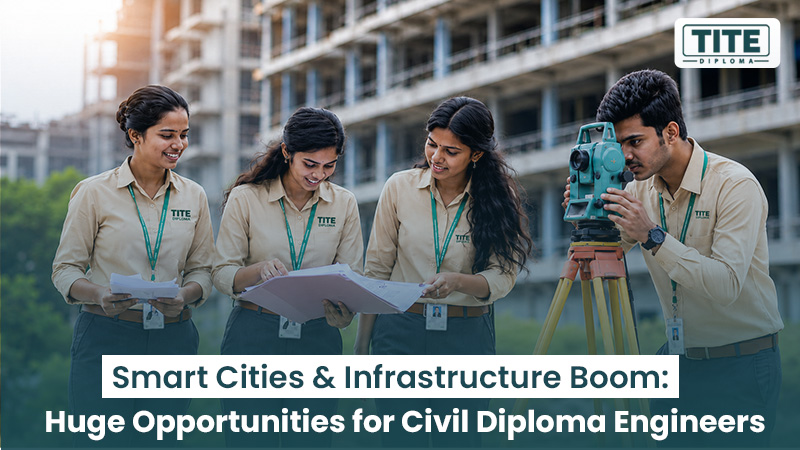
Smart Cities & Infrastructure Boom: Huge Opportunities for Civil Diploma Engineers
Summary: India's rapid urbanization and large-scale infrastructure development are driving strong demand for skilled civil diploma engineers. From smart city projects and sustainable construction to transportation networks and modern urban planning, diploma holders have diverse career opportunities across government and private sectors.
India is witnessing one of the biggest infrastructure transformations in its history. Rapid urbanization, the expansion of highways, metro rail networks, industrial corridors and smart urban infrastructure are creating a strong demand for skilled civil engineering professionals. Initiatives such as PM Gati Shakti and the Smart Cities Mission have accelerated the pace of development, with more than 94% of over 8,000 Smart Cities Mission projects completed across 100 cities and massive investments continuing in multimodal infrastructure. This has made Diploma in Civil Engineering colleges in Bhubaneswar an excellent choice for students who want to build rewarding careers in construction, project execution, surveying and infrastructure development.
For aspiring civil engineers, this infrastructure boom represents far more than increased employment, it offers opportunities to work on projects that shape the future of India's cities and transportation networks. From smart roads and sustainable buildings to bridges, airports and urban utilities, diploma graduates are becoming an integral part of the nation's development. Institutions like TITE provide industry-focused technical education and practical training that prepare students for these emerging opportunities.
Why Civil Diploma Engineers Are in Demand
India's growing investment in infrastructure has significantly increased the need for skilled civil engineering professionals who can contribute from the very beginning of a project. Civil diploma engineers are highly valued because their education emphasizes practical knowledge, technical skills and industry exposure, enabling them to take on site-based responsibilities immediately after graduation. Students graduating from Civil diploma colleges in Odisha are well-positioned to meet this demand, as they receive training that aligns closely with the requirements of construction companies, infrastructure developers and government agencies.
- Practical, hands-on skills valued on construction sites \- Diploma programmes focus extensively on practical learning through laboratory sessions, surveying exercises, construction workshops, site visits and project-based training. Unlike purely theoretical education, diploma graduates are familiar with construction materials, structural drawings, surveying instruments, concrete testing and field measurements. This hands-on expertise enables them to work efficiently on active construction sites with minimal additional training.
- A cost-effective workforce for contractors and infrastructure agencies \- Construction firms often require a large technical workforce capable of managing day-to-day project execution. Civil diploma engineers offer an excellent balance between technical competence and affordability, making them valuable additions to project teams. They support senior engineers by supervising construction activities, coordinating labour, maintaining project documentation and ensuring work progresses according to approved plans and specifications.
- Well-suited for technical roles required during project execution- The curriculum of a diploma in civil engineering directly prepares students for several essential roles in the construction industry. These include:
- Site Supervisor responsible for monitoring daily construction activities.
- Surveyor conducting land measurements and layout planning.
- Quality Control Technician ensuring construction materials and workmanship meet prescribed standards.
- CAD Draftsman preparing technical drawings and construction plans.
- Quantity Estimator calculating material requirements, project costs, and bills of quantities.
- Junior Civil Engineer assisting in project planning, execution, and documentation.
These roles form the backbone of every infrastructure project, making diploma graduates indispensable throughout the construction lifecycle.
- Faster deployment during construction phases compared to full-degree hires \- Since diploma education is designed to develop job-ready technical skills, employers can deploy diploma engineers to project sites much sooner. They require less orientation for routine construction activities such as site inspections, measurement recording, quality checks, safety compliance and contractor coordination. This allows companies to quickly mobilize manpower during critical phases of infrastructure projects, helping maintain project schedules and improve overall efficiency.
As India's infrastructure sector continues to expand through highways, railways, smart cities, industrial parks, airports, and residential developments, the demand for competent civil diploma engineers is expected to remain strong. Their practical expertise, technical versatility and ability to contribute immediately make them an essential part of the country's ongoing construction and urban development initiatives.
High-Demand Roles & Job Profiles for Civil Diploma Engineers
The rapid expansion of infrastructure, smart cities, industrial projects, and sustainable construction has created a wide range of career opportunities for diploma holders. Students pursuing a diploma in civil engineering Odisha gain the technical knowledge and practical skills required to work across construction, infrastructure planning, surveying, quality assurance, and facility management. Below are some of the most in-demand job profiles in the industry.
Site Supervisor / Junior Site Engineer
Site Supervisors and Junior Site Engineers play a vital role in ensuring construction projects are executed according to approved drawings, timelines, and safety standards. They coordinate with contractors, monitor labour productivity, inspect construction quality, maintain site records, and report project progress to senior engineers.
Typical employers:- Construction companies
- Infrastructure developers
- Real estate firms
- Government contractors
- EPC (Engineering, Procurement & Construction) companies
QA/QC Technician (Quality Assurance & Quality Control)
QA/QC Technicians ensure that construction materials and workmanship comply with industry standards and project specifications. They perform tests on concrete, cement, steel, aggregates, and other construction materials while maintaining quality documentation and inspection reports.
Key responsibilities:- Material testing
- Site inspections
- Quality documentation
- Compliance with IS codes and project standards
- Coordination with project engineers
- ISO 9001 Quality Management
- NDT (Non-Destructive Testing)
- Concrete Testing certifications
- Internal Quality Auditor programmes
Junior Estimator / Quantity Surveyor
Quantity Surveyors and Estimators help construction companies control project costs by calculating material quantities, preparing estimates, monitoring budgets, and assisting in tender preparation.
Important skills and tools:- Quantity take-off
- Rate analysis
- Cost estimation
- BOQ (Bill of Quantities) preparation
- Microsoft Excel
- AutoCAD
- CostX, PlanSwift, or similar estimation software
- Basic knowledge of project scheduling
This role is highly sought after in both public infrastructure and private construction projects.
Surveyor
Surveyors are responsible for accurately measuring land, establishing construction layouts, and providing precise site data before and during construction. Infrastructure projects rely heavily on accurate surveying to ensure structural safety and project accuracy.
Equipment and software familiarity:- Total Station
- Auto Level
- Theodolite
- GPS surveying equipment
- Drone surveying (basic knowledge)
- GIS software
- CAD mapping tools
Surveying skills are particularly valuable for highway, railway, bridge, mining, and urban development projects.
BIM Technician (Entry-Level)
As smart infrastructure projects become increasingly digital, Building Information Modelling (BIM) has become an essential part of modern construction. Entry-level BIM Technicians assist engineers and architects by creating and updating intelligent 3D building models.
Key responsibilities:- Preparing 3D digital models
- Coordinating architectural and structural drawings
- Detecting design clashes
- Updating project documentation
- Supporting project planning and visualization
Knowledge of software such as Autodesk Revit, Navisworks, and AutoCAD can significantly improve employability.
You can also read: Why Civil Engineering Diploma is a Smart Career Choice After 10th
Maintenance & Operations Technician for Smart Utilities
Smart cities require continuous maintenance of urban infrastructure, including water supply systems, drainage networks, roads, public buildings, and utility services. Maintenance Technicians ensure these systems operate efficiently through regular inspections, repairs, and preventive maintenance.
Typical responsibilities:- Utility inspections
- Asset maintenance
- Infrastructure monitoring
- Coordination with municipal engineering teams
- Basic troubleshooting of smart utility systems
This role is becoming increasingly important as cities adopt IoT-enabled infrastructure and digital asset management systems.
Field Safety Officer / Environmental Compliance Assistant
Construction companies place significant emphasis on workplace safety and environmental protection. Field Safety Officers help ensure compliance with occupational health, safety regulations, and environmental standards throughout project execution.
Responsibilities include:- Conducting site safety inspections
- Monitoring PPE compliance
- Reporting hazards and incidents
- Supporting environmental management plans
- Assisting with waste management and pollution control
- Organising safety awareness programmes for workers
Additional certifications in Industrial Safety, NEBOSH, IOSH, or Environmental Management can further enhance career prospects in this field.
With India's ongoing investment in smart cities, transportation networks, industrial infrastructure, and sustainable urban development, these job roles offer excellent career opportunities for civil diploma graduates. By combining practical skills with knowledge of modern construction technologies and digital tools, diploma holders can build stable and rewarding careers in the evolving infrastructure sector.
Technical Skills Employers Want
Today's construction and infrastructure industry expects civil engineers to possess more than just theoretical knowledge. Employers increasingly prefer candidates who can combine traditional civil engineering expertise with digital tools and smart infrastructure technologies. Students pursuing a Civil engineering lateral entry diploma can gain a competitive advantage by developing these in-demand technical skills alongside their academic curriculum.
- AutoCAD and Technical Drafting
AutoCAD remains one of the most essential software tools in civil engineering. Employers expect diploma engineers to prepare and interpret construction drawings, site layouts, structural plans, utility maps, and detailed engineering designs. Strong drafting skills help professionals communicate project requirements accurately and reduce construction errors.
- Revit and Building Information Modelling (BIM) Basics
Modern infrastructure projects increasingly use BIM to create intelligent 3D models that integrate architectural, structural, and MEP (Mechanical, Electrical, and Plumbing) information. Basic knowledge of Autodesk Revit and BIM workflows enables diploma engineers to collaborate effectively with multidisciplinary project teams and contribute to digital construction projects.
- Surveying Using Total Station and GPS Equipment
Accurate surveying is fundamental to every construction project. Employers look for candidates who are familiar with Total Station instruments, GPS surveying equipment, auto levels, and theodolites. These tools are widely used for land measurement, site layout, road alignment, and infrastructure planning.
- RCC and Structural Steel Detailing
Civil diploma engineers should understand reinforced cement concrete (RCC) construction, steel structures, reinforcement detailing, and reading structural drawings. This knowledge is essential for supervising construction activities and ensuring that structures are built according to approved engineering designs.
- Quantity Take-Off and Estimation Software
Infrastructure companies require engineers who can accurately estimate material quantities, calculate project costs, and prepare Bills of Quantities (BOQs). Familiarity with Microsoft Excel, AutoCAD-based quantity take-off tools, CostX, PlanSwift, or similar estimation software improves efficiency and supports effective project planning.
- Basic Geographic Information System (GIS) Knowledge
GIS technology is increasingly used in urban planning, transportation projects, utility mapping, and smart city development. Understanding spatial data, digital mapping, and GIS applications helps engineers support infrastructure planning and asset management activities.
- Construction Materials Testing
Employers value engineers who can perform quality tests on concrete, cement, aggregates, steel, bricks, and bitumen. Knowledge of laboratory testing procedures, field testing methods, and relevant Indian Standards (IS codes) helps ensure construction quality and regulatory compliance.
Digital & Smart City-Specific Skills
As India adopts smart infrastructure and digital construction practices, employers also seek professionals who understand emerging technologies used in modern urban development.
- Internet of Things (IoT) Fundamentals
Smart cities rely on connected devices to monitor traffic, water supply, street lighting, waste management, and public infrastructure. A basic understanding of IoT concepts helps civil engineers work effectively on technology-enabled infrastructure projects.
- SCADA (Supervisory Control and Data Acquisition) Basics
SCADA systems are widely used to monitor and control utilities such as water treatment plants, power distribution, and industrial infrastructure. Familiarity with SCADA concepts allows civil engineers to better understand the operation of automated public utility systems.
- Sensor Networks and Smart Infrastructure Monitoring
Modern bridges, tunnels, buildings, and highways increasingly use sensors to monitor structural health, environmental conditions, traffic flow, and maintenance requirements. Knowledge of sensor-based monitoring systems helps engineers support predictive maintenance and improve infrastructure safety.
- Building Management System (BMS) Awareness
Commercial buildings, hospitals, airports, and smart campuses use Building Management Systems to control lighting, HVAC, fire safety, security, and energy consumption. Understanding how BMS operates enables civil engineers to coordinate effectively with multidisciplinary engineering teams during construction and facility management.
Developing these technical and digital skills not only enhances employability but also prepares civil diploma graduates to work on next-generation infrastructure projects. As smart cities, sustainable construction, and digital engineering continue to evolve, professionals with a strong combination of practical civil engineering knowledge and modern technology skills will remain in high demand.
Professional Certifications That Can Boost Your Civil Engineering Career
Earning additional certifications alongside a diploma in civil engineering Odisha can significantly improve your employability and career growth. These certifications demonstrate your commitment to continuous learning and equip you with specialized skills that are highly valued by construction companies, infrastructure developers, consulting firms and government agencies.
- NPTEL Certification Courses
The National Programme on Technology Enhanced Learning (NPTEL) offers online courses developed by IITs and IISc. Civil engineering students can choose subjects such as Structural Engineering, Transportation Engineering, Geotechnical Engineering, Construction Management, Surveying and Project Planning. These certifications strengthen technical knowledge and are recognized by many employers.
- NCVT Skill Development Programmes
Training programmes and skill certifications aligned with the National Council for Vocational Training (NCVT) help students gain practical expertise in areas such as surveying, construction supervision, CAD drafting, welding inspection and equipment operation. These industry-oriented certifications enhance hands-on skills required at construction sites.
- Building Information Modelling (BIM) Foundation Certification
As the construction industry shifts towards digital project execution, BIM certification has become increasingly valuable. Learning software such as Autodesk Revit, Navisworks and BIM workflows prepares diploma engineers to work on smart infrastructure, commercial buildings, metro projects, airports and industrial facilities.
- Occupational Health & Safety Certifications (NEBOSH/OSHA Basics)
Safety is a critical aspect of every construction project. Basic certifications based on NEBOSH or OSHA standards provide knowledge of workplace safety practices, hazard identification, risk assessment, emergency response and accident prevention. These qualifications are particularly useful for engineers working on large infrastructure and industrial projects.
- Construction Quality Control and Materials Testing
Short-term certification programmes in concrete testing, soil testing, non-destructive testing (NDT) and quality assurance help engineers develop expertise in maintaining construction standards and ensuring compliance with engineering specifications.
- AutoCAD and Civil Engineering Software Certifications
Certified training in AutoCAD, Civil 3D, STAAD.Pro, ETABS, MS Project and quantity estimation software enhances technical capabilities and prepares students for roles in design support, planning, estimation and project execution.
- GIS and Remote Sensing Certification
Geographic Information System (GIS) and Remote Sensing courses are becoming increasingly relevant in urban planning, highway development, land surveying, utility mapping and smart city projects. These skills are highly valued in government infrastructure and environmental projects.
- Project Management and Primavera P6 Training
Learning project scheduling and management tools such as Primavera P6 or Microsoft Project enables diploma engineers to assist in planning, resource allocation, progress tracking and timely project completion.
By combining a diploma qualification with industry-recognized certifications, students can broaden their technical expertise, improve their job readiness, and stand out in a competitive recruitment market. Continuous skill development not only increases employment opportunities but also opens pathways to higher-paying roles and long-term career advancement in India's rapidly growing infrastructure sector.
Salary Expectations & Career Progression for Civil Diploma Engineers
The salary of a civil diploma engineer depends on factors such as location, employer, project size, technical skills, certifications, and work experience. Professionals working in metropolitan cities generally receive higher salaries due to larger infrastructure projects and higher living costs, while opportunities in Tier-2 and Tier-3 cities offer steady career growth with lower competition. As engineers gain experience and develop expertise in areas such as project management, BIM, quality assurance, or estimation, their earning potential increases significantly.
| Career Stage | Typical Job Roles | Estimated Monthly Salary (India) | Career Growth |
|---|---|---|---|
| Entry Level (0-2 Years) | Site Supervisor, Junior Site Engineer, Surveyor, QA/QC Technician, CAD Draftsman | Tier-2/Tier-3 Cities: ₹18,000-₹28,000Metro Cities: ₹25,000-₹40,000 | Gain practical site experience, technical software skills and project exposure. |
| Early Career (3-5 Years) | Project Coordinator, Quantity Surveyor, Site Engineer, BIM Technician | ₹35,000-₹60,000 | Handle independent project responsibilities, supervise teams and manage client coordination. |
| Mid-Career (5-10 Years) | Project Engineer, Site Manager, Quality Manager, Planning Engineer | ₹60,000-₹1,00,000+ | Lead construction projects, manage budgets, schedules, quality and contractor teams. |
| Senior Level (10+ Years) | Senior Project Manager, Construction Manager, Consultant, Infrastructure Manager | ₹1,00,000-₹2,00,000+ (depending on organisation and project scale) | Oversee multiple projects, strategic planning, business development and technical leadership. |
Long-Term Career Progression
- Project Management: With experience and additional certifications, diploma engineers can move into project planning, execution, contract management, budgeting and leadership roles.
- BIM & Digital Construction: Specialising in Building Information Modelling (BIM), Autodesk Revit, Navisworks and digital project coordination opens opportunities in smart infrastructure and large commercial projects.
- MEP Coordination: Developing expertise in Mechanical, Electrical, and Plumbing (MEP) coordination allows professionals to work on integrated building projects, hospitals, airports, malls and industrial facilities.
- Quantity Surveying & Cost Management: Engineers can specialise in estimation, contract administration, tender management and cost control for infrastructure and real estate projects.
- Quality & Safety Management: Certifications in quality assurance, industrial safety, and environmental compliance can lead to senior QA/QC and HSE management positions.
- Higher Education: Many diploma holders pursue lateral entry into B.Tech or advanced certifications to qualify for higher technical and managerial roles in the construction and infrastructure sector.
India's smart cities, transport corridors, industrial infrastructure, and sustainable urban development projects are creating unprecedented opportunities for skilled civil engineering professionals. Choosing one of the leading Diploma in Civil Engineering colleges in Bhubaneswar can provide students with the practical knowledge, industry exposure, and technical skills needed to succeed in this rapidly growing sector. With the right combination of hands-on training, digital competencies, and professional certifications, civil diploma graduates can build rewarding careers while contributing to the nation's infrastructure development.
If you're ready to begin your journey in civil engineering, take the next step by submitting your online application. A quality diploma programme can open doors to exciting career opportunities in construction, smart infrastructure, government projects and higher education.
-

-

-
.jpg) Mining Engineering Diploma Course With Practical Field Training August 21, 2026
Mining Engineering Diploma Course With Practical Field Training August 21, 2026 -

-